

Immersive Storytelling Opens Contemporary Art to Children
Exploring the Future of Spatial Cinema
Lightning Interview with Bálint Benkovits, Director (Derengő Animation Studio)
Q: You are working on a three-part immersive project, the first part of which was presented in Veszprém, Hungary, at the CODE Digital Experience Center — where does the project stand now?
Bálint Benkovits:
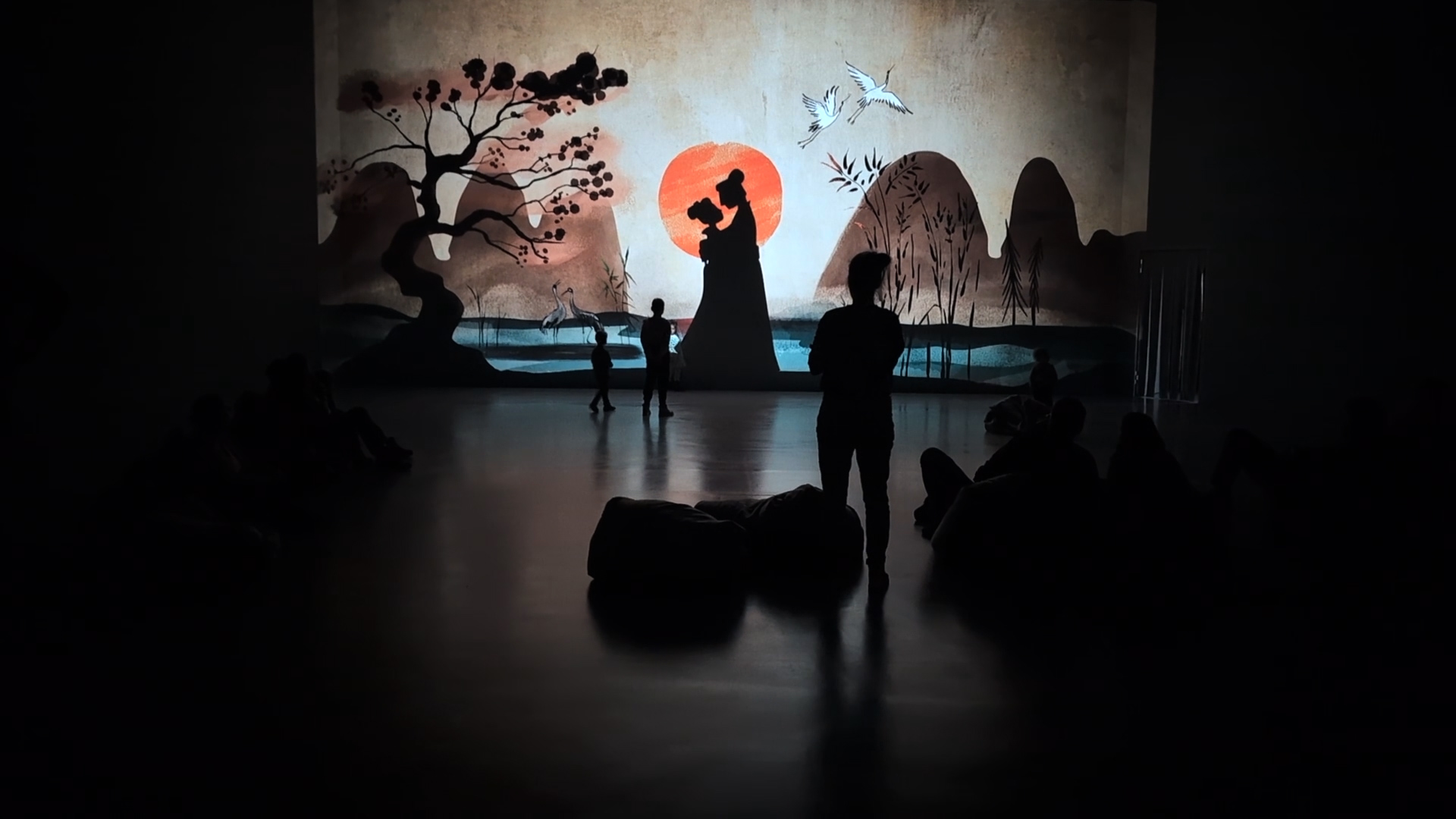
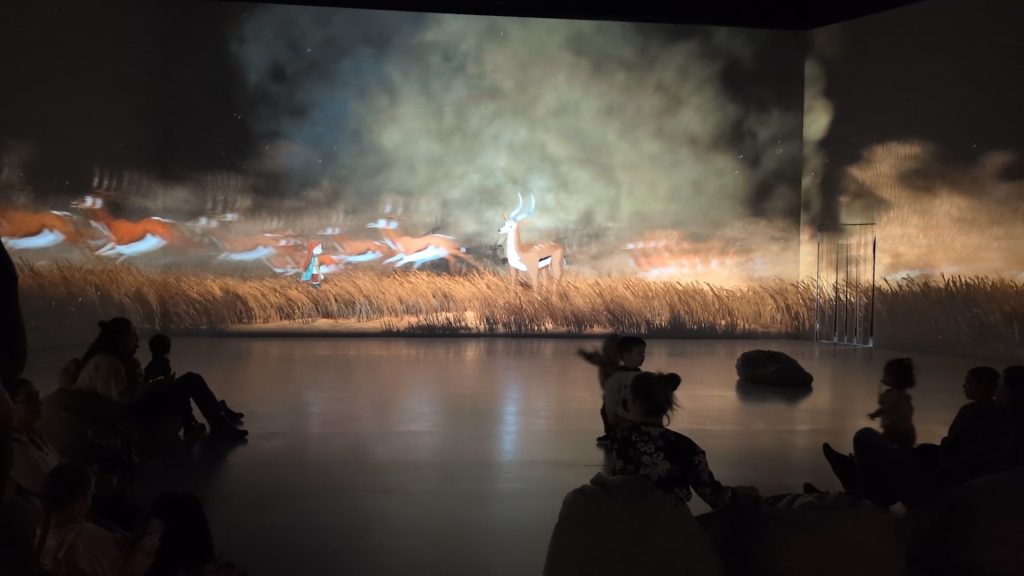
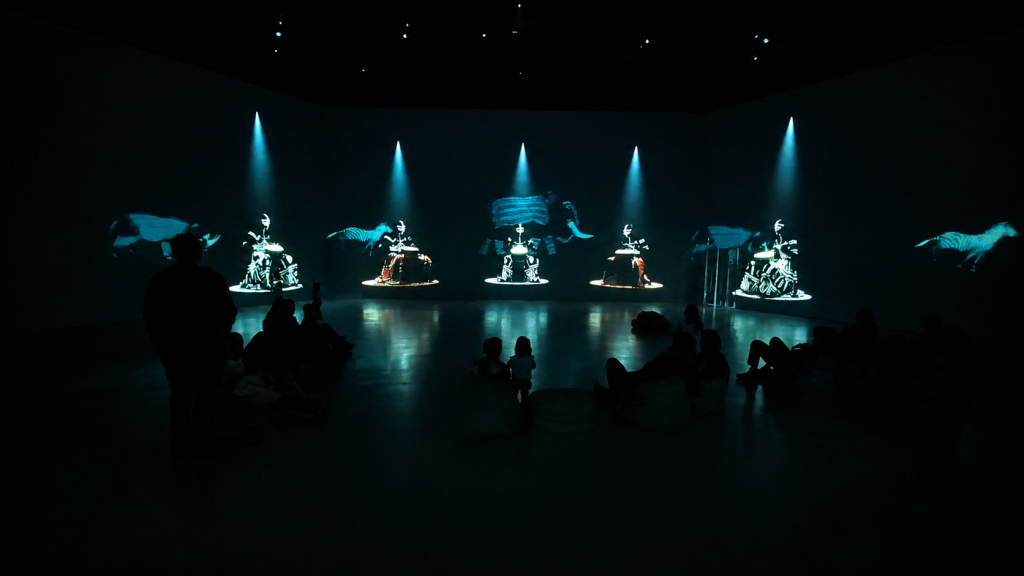
Yes — the first episode of Hidden Sounds was presented at CODE Veszprém in Hungary, within their Hexagon immersive space, which is a 360° projection environment with a 72×6 meter surrounding screen and a 400-square-meter floor projection system.
The project itself was developed at Derengő Animation Studio. It is a three-part immersive audiovisual work, structured as a culturally sensitive 3×25-minute spatial experience, combining full 360° visuals with spatial (4D) sound. The key idea is that the audience is not outside the film anymore — they are physically inside the narrative environment.
CODE Veszprém is not just a venue, but part of the medium itself. Its Hexagon space combines 360° projection and spatial sound, turning the work into a fully immersive environment rather than something viewed from the outside. The audience is inside the experience, moving through the space and choosing where to look, which fundamentally changes how the story is perceived.
Visitors also receive an RFID wristband or card that activates nine hidden mini-kiosks throughout the installation. These unlock fragments of the story, sounds, and instruments, creating a “sound hunt” that guides the journey and encourages active participation.
As audiences move through the space, panoramic projections lead them across different cultures, myths, and visual motifs, gradually revealing the narrative layers of the work.
The visit typically lasts 60–90 minutes and is supported by bilingual visuals, icons, short texts, and staff guidance, making it accessible as a family-friendly immersive experience.
At this stage, Episode 1 is completed and has been publicly presented, while Episodes 2 and 3 are currently in development, where we are continuing to refine both the narrative structure and the immersive spatial language of the project.
Q: Why “immersive storytelling”? What does it mean for you?
Bálint Benkovits:
I’ve always been interested in bringing audiences closer to the medium and exploring new ways of storytelling. Looking back, Hidden Sounds feels like the result of more than twenty years of experimentation.
During my university years, I became fascinated by non-linear narratives and the relationship between audience, image, and story. This led me into the VJ scene, where we helped establish the first Hungarian VJ Conference at the Uránia Cinema, contributing to the recognition of VJing as an artistic medium. Later, with the Omkamra art collective and artists from the Vajda Lajos Studio, I worked on interactive audiovisual performances, experimental animation, and installation art.
I was always trying to move beyond the traditional screen and create experiences where projection, space, and audience perception became part of the same artwork. Through my work at Drip Design Studio, the projection-mapping collective Glowing Bulbs, and later Derengő Animation Studio, I explored animation, visual storytelling, projection mapping, and large-scale immersive environments.
What excites me about immersive storytelling is that it brings all these disciplines together. It combines animation, contemporary art, music, technology, and performance into a single experience. We live in a world overwhelmed by information and constant noise, and immersive spaces offer something increasingly rare: focused attention. Instead of simply watching a story, the audience enters it. This is especially true for younger audiences, who are still forming their own internal frameworks of reference and value. For me, that is where the real potential of this medium lies.
Q: How is this different from traditional animation?
Bálint Benkovits:
In this work, we no longer operate with a frame — we operate with space itself. Hidden Sounds is built around a 6+1 camera system that captures the environment in all directions simultaneously, including the floor. There is no privileged viewpoint, no single screen where the narrative unfolds. Instead, the story exists all around the viewer, and is perceived through movement and orientation.
Traditional editing is also largely replaced. Rather than cuts, we work with spatial transitions — extended sequences, typically 20–30 seconds long, that function as navigational passages between environments.
Technically, the project is developed in Unreal Engine, combining 2D illustration, layered compositing, and full 3D reconstruction depending on the spatial requirements of each scene. The main character, Zamira, exists across multiple dimensional states — sometimes flat, sometimes fully volumetric — depending on how she is embedded in the environment.
What emerges is less a traditional animated film and more a form of spatial composition, where image, sound, and architecture are treated as a single, integrated system of storytelling.
Q: Who are the key artists behind the project?
Bálint Benkovits:
This is not a single-author work — it is a collaborative system. Screenwriter György Somogyi built the myth-based narrative structure, where each episode connects cultural legends around sound. Composer and sound designer Csilla Domonkos created the entire musical architecture as a spatial system — not a score in the traditional sense, but a narrative sound field. Visual artist Annamária Megyeri designed the layered visual world, where every element exists as part of a spatial composition rather than a flat illustration. And the final immersive sound mix was realized by Oscar-winning film Son of Saul’s sound designer Tamás Zányi, who shaped sound as a physical presence in space.
The project is being developed and produced at Derengő Animation Studio, a Budapest-based CGI production house specializing in stylized animation, immersive visual experiences, and innovative storytelling.
Their work ranges from animated series and family content to motion graphics, interactive installations, LED visuals, and projection mapping. By combining traditional artistry with contemporary 2D and 3D techniques, they create distinctive visual worlds that work both on screen and in physical space.
Derengő’s productions integrate detailed handcrafted design with advanced animation workflows, focusing on meaningful, visually engaging storytelling across a wide range of formats and audiences.
Q: Can you tell us more about the main character, the story, and its message?
Bálint Benkovits:
The story of Hidden Sounds takes place in a world overwhelmed by media noise, where sound itself is slowly disappearing. In this environment, a young girl named Zamira becomes the central figure of the journey.
The sounds of the world have been stolen by a mysterious force known as the Great Noise. Birdsong has vanished, and silence spreads wherever the Great Noise passes. Whenever Zamira manages to awaken a forgotten sound from an ancient instrument, the Great Noise appears and relentlessly pursues her, determined to capture and erase it once again.
She is not a traditional hero, but a curious, perceptive presence who moves through different cultures and mythologies in search of what has been lost.
Her journey leads her to ancient instruments that each carry a fragment of memory and identity — a flute in the mountains, a djembe in Africa, a koto in Japan. These are not just musical objects, but cultural carriers: each sound holds emotional and historical meaning tied to its origin.
As Zamira collects these sounds, the world around her gradually shifts. The fragmented noise of the present begins to transform into something structured and meaningful. In the final part of her journey, the sounds are reborn within a symphonic space, where even the “Great Noise” itself changes form and becomes music.
At its core, the story is about transformation — how chaos can become meaning, and how listening can become a way of understanding the world again.
Q: Do you see a future for this medium?
Bálint Benkovits:
Yes — but not in its current form. Right now, immersive storytelling is often still understood as expanded cinema: bigger screens, more projection, more spectacle. But its real potential is not scale, it is spatial dramaturgy.
We are moving toward a language where narrative is no longer strictly linear, attention is distributed across space, sound becomes architectural, and the viewer is physically embedded within meaning rather than positioned in front of it.
This is not simply an evolution of film — it is the early stage of a new medium, and we are still in the process of learning its grammar.
Q: What do you want the audience to take away?
Bálint Benkovits:
We live in an increasingly noisy world — not only acoustically, but emotionally and cognitively. Hidden Sounds does not seek silence; it seeks understanding. It invites us to listen more deeply, to perceive the hidden relationships between signal and noise, order and chaos, technology and human experience.
At its core, the project explores how stories can exist beyond the boundaries of a screen — as immersive environments that engage the body, the senses, and the imagination. In a time when attention is fragmented, perhaps the most meaningful stories are those that invite us not only to watch, but to truly listen.
In that sense, Hidden Sounds is less about providing answers and more about creating the conditions for attention, curiosity, and discovery.