

Preservation Through Transformation: Kecskemétfilm Starts a New Chapter
On generational change, cultural heritage, and international competitiveness – Ferenc Mikulás and László István Tóth on redefining a 55-year-old animation studio for the future.
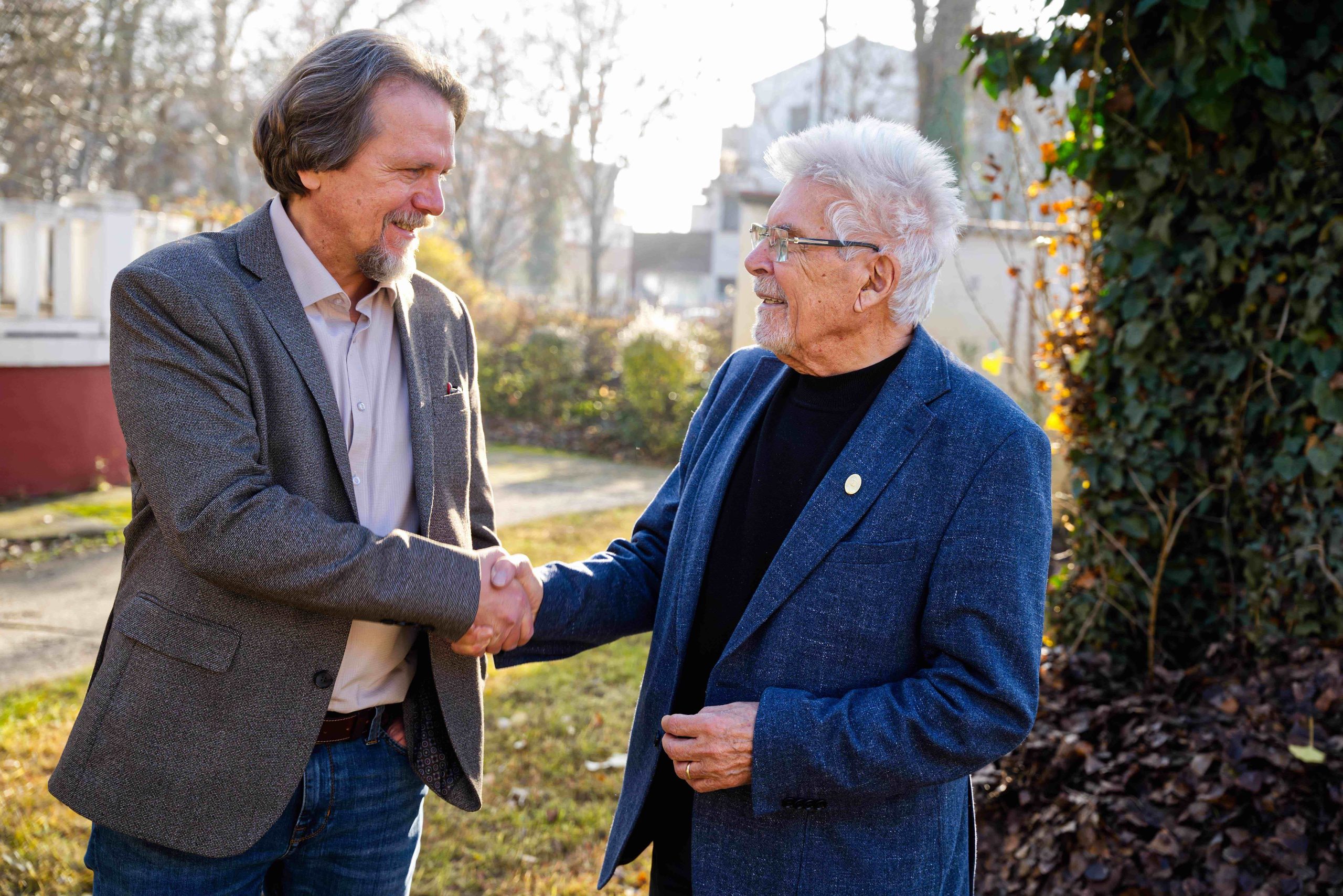
In early January 2026, leadership of the Kecskemétfilm Animation Studio was taken over by one of its long-standing and defining collaborators, László István Tóth, from Ferenc Mikulás, who had headed the Kecskemét Animation Studio for 54 years. In 1971, Pannónia Film Studio decided to establish a regional branch outside Budapest. At first, the new studio participated in Pannónia’s productions only as a contributing partner; later, it began producing its own independent films. Kecskemétfilm Ltd. has since become one of Hungary’s leading animation studios. The studio is active in both the domestic and international film markets, with a wide range of productions. Its portfolio primarily includes artistic short films, series, feature-length animated films, as well as educational and commercial works.
What does a “smooth transition” mean in the case of an animation studio that has been operating for 55 years? Is it primarily a professional, human, or institutional challenge?
Ferenc Mikulás: László has been a colleague at the studio for several decades. He has worked on both Hungarian and international productions in various roles, so he knows the studio from the inside. I can perhaps contribute more on the level of institutional relations. This situation is a challenge in every respect, especially if we take the broader professional and social environment into account.
László István Tóth: From a legal perspective, the transition is smooth: from one day to the next, the signing authority on corporate documents changes. In practice, however, we are talking about a transition period lasting several months. Although I have spent more than three decades at the animation studio, as the new managing director I also need to familiarize myself with areas I have not previously dealt with. Ferenc Mikulás is now introducing me to these as well. Therefore, among the options listed in the question, I would describe the challenge as institutional, and at the same time professional.
One of the cornerstones of Kecskemétfilm is the animated adaptation of Hungarian cultural traditions. How can this mission be made relevant in the 21st century for new audiences as well?
FM: Perhaps the best example of processing cultural traditions is the Hungarian Folk Tales series. These stories follow a universal pattern in which the protagonist is surrounded by difficulties and trials, friends and enemies along the way, until they finally reach the great conflict and earn their rightful reward. The essence of these tales is that they present a universally valid, archetypal life strategy for every human being – which is why they remain relevant in any era. We transformed folk art motifs into a contemporary visual language, and the music also supports the stories in a timeless way.
(Today, the English, Chinese, and Hungarian versions of Hungarian Folk Tales have 218 million (!!) viewers worldwide, and this number is growing by one million every month.)
LIT: Over the past 55 years, a great many creators have contributed to the studio’s reputation. Going forward, one of our pillars will continue to be drawing from the vast reservoir of Hungarian culture – adapting valuable works and the stories of defining personalities. In this, we also rely on the ideas and participation of young creators who, having been socialized in the 21st century, bring a fresh perspective to the art of animated filmmaking.
For an animation studio in a small country, what does “international competitiveness” mean today? Is it decided by style, choice of themes, or production structure?
FM: Competitiveness is ensured by our existing film catalogue and by the artistic quality of our current creative teams. A generational change is currently underway at the studio. It is crucial who, and in what way, will be able to participate as creators in making films in the future.
LIT: A European animation studio does not become competitive by producing large quantities of content at lightning speed – that is the strength of Asian companies. As a Hungarian studio, we need to focus on high quality and expertise; here too, the principle that “less is more” may apply. In addition, good and effective intercultural communication is indispensable.
What would be the one sentence that, ten years from now, would best summarize the significance of the period that is now beginning?
FM: Perhaps I would like to read the phrase “preservation through transformation” in connection with the studio ten years from now.
LIT: This was the decade when Kecskemétfilm redefined itself on the basis of its traditional cinematic values, creating renewal while preserving its soul and becoming a long-term point of reference.
To LIT: After decades of internal professional experience, where do you see the greatest challenge of the managing director’s role?
Creating a financial balance that ensures long-term predictability of revenues and expenditures, and stable, reliable planning.
To FM: At the close of your period as director, how do you view the history of Kecskemétfilm? What do you consider an essential value that must be passed on?
I often say that we must preserve the national values we are born into, and pass them on using continuously renewing technological possibilities. These values are renewed and expanded from generation to generation; I am not thinking of an outdated, conservative form of preservation. I believe it is important to continue along this path.
To LIT: You have repeatedly emphasized the importance of talent development and mentoring. What skills does an early-career animator most need today?
In animated film production, a good animator possesses emotional sensitivity, inner acting ability, and confident drawing and anatomical knowledge. They know and apply the principles of animation – among which the two most important are timing and spacing. That is, they handle the individual elements of a movement sequence, the drawings, appropriately in time and space. Patience is also worth mentioning: creating just a few seconds of animation is often a long process. Instead of focusing on the large number of seemingly repetitive drawings – or poses in the case of 3D animation – one should concentrate on the beauty of complex movement. It is also essential for an animator to be adaptable, as they must adjust to others’ graphic and animation styles and to the director’s vision.
To FM: What was the most important lesson for you in working together with young creators?
At the time the studio was founded, most of the staff were not from Kecskemét, so the studio became not only their workplace but partly their home as well. Today, young people consider independence and the expression of their individuality to be important – it is more difficult to create a space that, alongside online presence, also enables cooperation within a real, physical community.
To LIT: Both the series presenting the lives of Hungarian saints and the feature film currently in preparation require long-term commitment. Where do you see their greatest risk and greatest promise?
Our series Confessions of Hungarian Saints can be realized from grant-based funding, episode by episode. If there are interruptions between episodes due to lack of funding, this leads to the crew drifting toward other projects, and it is not guaranteed that the same artists will be able to participate when the work continues. If the financing of the remaining episodes were to be secured all at once, the creative process would become smoother, ensuring a high professional standard for the completion of the series.
Since the release of Toldi, no new feature film has entered development, but it occupies a prominent place in our long-term plans.
To FM: How can the KAFF (Kecskemét Animation Film Festival) and the studio’s operation strengthen one another? How has the role of KAFF changed over the past decades on the Hungarian and international animation map?
I conceived the international scholarship program and the festival in the interest of the studio. I wanted my colleagues to see what is happening in animation around the world, and foreign creators, directors, and producers to see the values of Hungarian animation. In several cases, international guests of the festival later became our clients or collaborators. It also meant a great deal when the national festival became a showcase for European feature-length and television films. The presence of award-winning programs at our partner festivals presents the very best of Hungarian animation, and in recent years the number of domestic programs featuring festival selections has also increased. We are recognized and appreciated both at home and abroad.
To LIT: Contract and service work continues to play a defining role in the life of Kecskemétfilm. How can this strong international presence be maintained without compromising the studio’s independent identity and creative ambitions?
Whether it is a feature film, episodes of a series, a commercial, or a short film, we treat every commission as an exciting professional challenge. Even in the case of service work, we believe that a diverse visual world combined with strong storytelling guarantees the success of the films we contribute to. Our creative ambitions are continuously nourished by the collaborative work carried out during commissions, and we later capitalize on the valuable experience gained there in our own in-house development projects.
To FM: What preparations are necessary for the establishment of the House of Hungarian Animation?
A major step in preparing the realization of the House of Hungarian Animation was the declaration of intent by the National Film Institute and the City of Kecskemét (with county rights) regarding the creation of the museum. At present, the task is to collect the works of Hungarian animation artists at home and abroad, and to secure funding for the conversion of the building.